Customer feedback at scale, trapped in a monthly rebuild.
Personal Banking's White Label portfolio spans nine partner brands plus proprietary products. Every month, the Customer Experience team needs a single, trustworthy view of what customers are saying: complaints, NPS verbatims, themes, subthemes, and month-on-month trends. Product owners and executives use that view to decide what to fix next.
The data existed. The problem was what it took to turn it into something useful. The team was rebuilding a dense, 41-slide PowerPoint from scratch every month. Manual work and Copilot could not keep up with the volume. Copilot was limited when dealing with large volumes at once. The real dataset was closer to 30,000 verbatims across nine brands, 23 themes, and 170 subthemes.
"We need a consolidated, real-time view with insights from a huge volume of customer feedback. White Label needs a single, clear view of what customers are saying across all nine brands, themes, trends, and patterns, in a format the business could actually act on. The data is there. The problem is what it takes to turn it into something useful."
— Customer Experience Lead · Partner portfolio · Personal BankingOne source of truth that would not take two weeks to create.
I joined this as an AI enablement build: take a real operational pain point, solve it with Cursor under enterprise AI guardrails, and hand the system back to the team that owns the data. The brief was not a prettier deck. It was a durable product.
Six requirements, one system
One dashboard
A single source of truth. No monthly rebuild from scratch.
Themes and subthemes
Ranked, structured view of what customers are actually frustrated about, not just raw volume.
Month-on-month view
Move from static snapshots to trends: are things getting better or worse?
Actionable insights
Clear direction for product owners on what to do next, not just charts to interpret.
All nine brands
Switch between proprietary and White Label brands without rebuilding the analysis.
Reusable, repeatable process
A workflow the team runs themselves. Weeks of work compressed to hours.
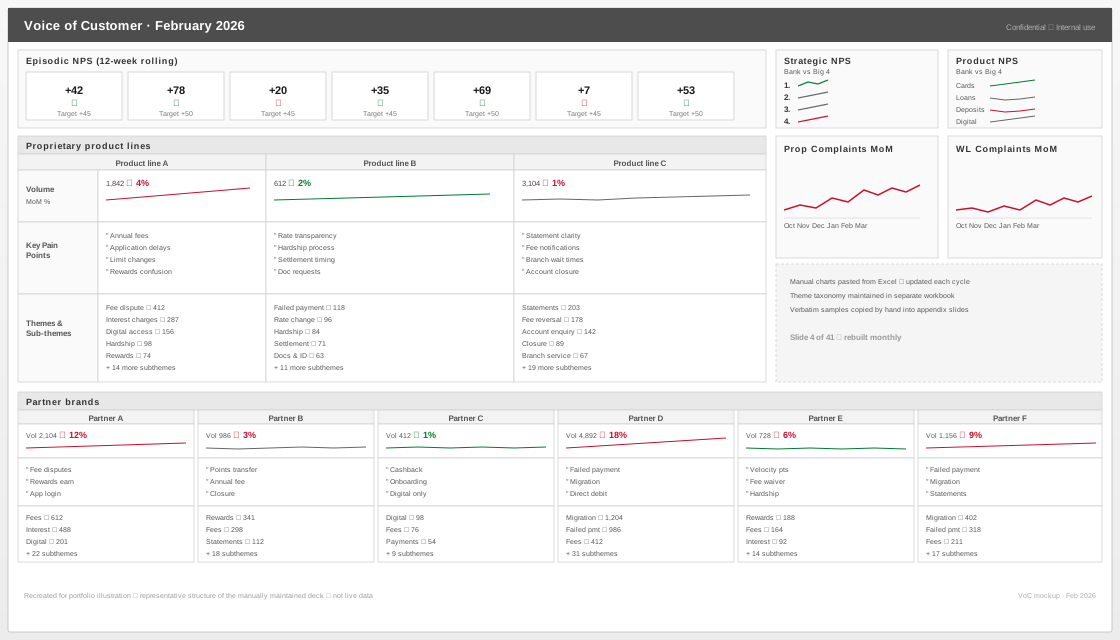
Before: the manually rebuilt PowerPoint each month, taking two weeks every time. Episodic NPS, proprietary products, and White Label partner brands assembled slide by slide. Recreated for portfolio — representative structure, not live data.
Plan mode first. Then four hours to a full system.
I started in Cursor Plan mode with the problem as the Customer Experience team described it: two weeks of manual synthesis, unsustainable at ~30,000 records, Copilot chunking that left gaps in interpretation. The plan had three deliverables: a data synthesis pipeline, a live dashboard, and a presentation template wired to the same structured output.
Data synthesis pipeline
Ingest raw complaint and NPS files. Output structured JSON and markdown tagged by product, theme, subtheme, and sentiment.
Live dashboard
Product switcher across proprietary and White Label brands. Theme breakdown, MoM and YoY charts, combined NPS and complaints view, verbatims browse, insights and actions.
Executive report template
Same synthesised data, internal design-system monthly presentation generated by command, not assembled by hand.

Live dashboard mockup — illustrative data, no bank branding.
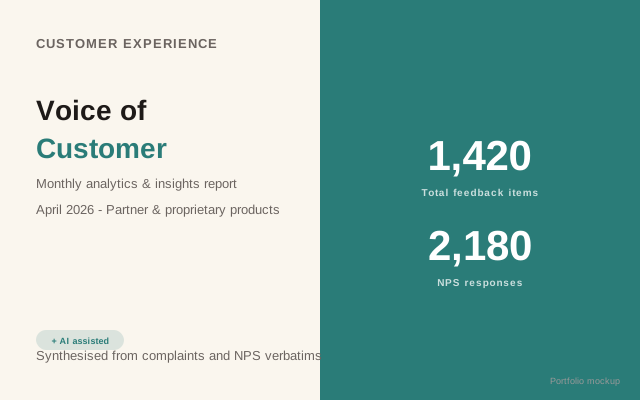
Generated exec report mockup — same data, one command.
Executive summary: insights the business can act on
The report is not a dump of charts. Synthesis surfaces ranked themes, quarter trends, and explicit recommendations product owners can run with. A generated summary page might flag a fastest-growing fee theme, NPS at a quarterly low, and a partner brand following a migration pattern the team has seen before, with a recommendation to intervene earlier than last time.
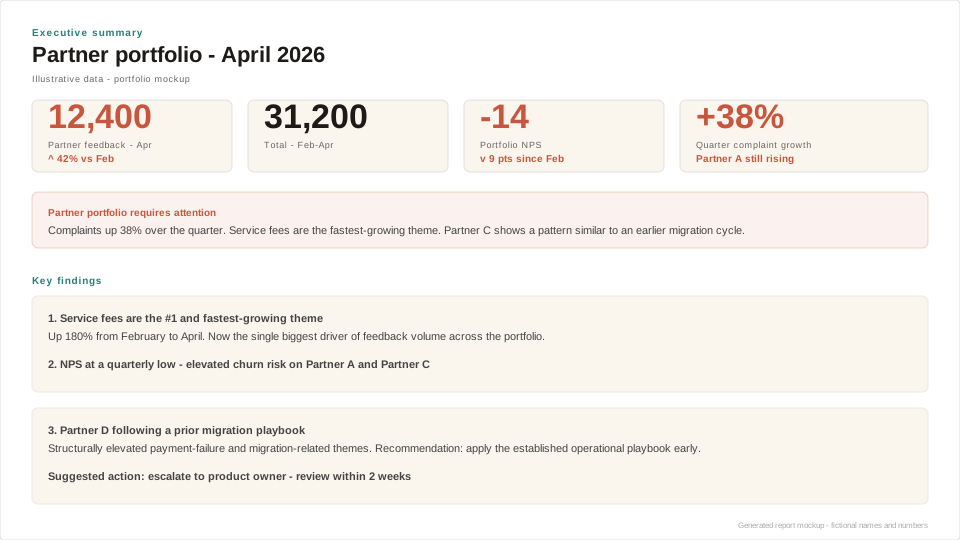
Generated executive summary mockup · illustrative partner portfolio · synthesised from complaints and NPS verbatims, reviewed before publish.
Designed for reuse. Next month: same five steps, same commands.
The product is not the first month's output. It is the repeatable workflow the team owns after handover. Two plain-English Cursor commands do the heavy lifting. A staging step keeps humans in control before anything goes live.
synthesise
Read everything, tag themes, build JSON
Cursor reads the full verbatim set in one pass, applies the team's taxonomy, learns from previous syntheses, and outputs structured data. No manual categorisation row by row.
present
Generate dashboard update and presentation
From the same synthesised files: refresh the live dashboard views and produce the monthly exec report from template.
golive
Promote approved data to production
Staging first. The team reviews themes, insights, and verbatims before approved data moves to the live site.
Monthly workflow (five steps, one day)
Prepare data
Export complaints and NPS verbatims. Remove PII.
Run /voc/synthesise
Cursor reads everything and outputs structured data to staging.
Review in staging
Team validates themes, insights, and verbatims before publish.
Publish to live
Run /voc/golive to promote approved data.
Run /voc/present
Presentation generated from live data. Share and done.
Value: two weeks to one day per month · full dataset synthesis · consistent design-system output · no developer dependency.
Gotchas we designed for: AI output is a strong first draft, not gospel. Prompts need context. Staging review is mandatory. Cursor is agentic: humans stay in control.
More time fixing problems, less time analysing them.
"Cursor reduces customer feedback analysis from two weeks to under a day, delivering more accurate theming at scale and a reusable, AI-powered dashboard, providing faster insights and more time spent fixing problems instead of analysing them."
— Customer Experience Lead · Partner portfolio · Personal BankingWhat changed
| Before | After |
|---|---|
| Two weeks of manual synthesis every month | One-day repeatable workflow the team runs themselves |
| Copilot limited on large-volume synthesis | Full ~30,000-record dataset processed in one synthesis run |
| 41-slide PowerPoint rebuilt from scratch | Live dashboard plus generated exec report from shared data |
| Static monthly snapshot, hard to compare trends | MoM complaint trends, theme rankings, brand switcher, verbatims browse |
| Analysis work owned by one person, not scalable | Documented commands, staging review, and handover to the owning team |
This sits alongside ADG as a Generation-phase proof on the Context Lifecycle: governed AI that turns fragmented organisational data into something teams can act on, with mandatory human review before anything ships.
The demo was the product strategy.
This build started as a live Cursor demo for Personal Banking leadership: solve a real problem in the room, hand the system to the team that owns it, show what agentic AI looks like when it respects enterprise guardrails. That framing kept the scope honest. We were not pitching a concept. We were replacing a two-week manual process with something the Customer Experience team could run next month without me in the loop.
What made it work was treating synthesis as a pipeline, not a one-off prompt. Themes learned over time. Staging existed because AI theming at scale is a strong first draft, not a final answer. The commands (/voc/synthesise, /voc/present, /voc/golive) are the product: the dashboard and the deck are outputs.
What I would do differently: invest in classification coverage tooling earlier. The dashboard surfaced a review queue for unclassified verbatims; making that visible from day one would have shortened the trust-building phase with stakeholders who were used to manually checking every row.
Four hours to build. Two weeks to one day per month. Handed to the team that runs it.