The platform was ready. The people were not.
I had built the Context Lifecycle, a governed AI knowledge platform for the domain, and shipped the Agentic Document Generator, which lets POs and BAs draft requirements with AI against shared context. With executive mandate to scale across thousands of staff in the Banking Domain, the infrastructure worked. Adoption did not follow automatically.
Team members had wildly different levels of AI confidence. Some had never opened Cursor. Others were prompting daily but without guardrails. Technical roles could self-direct through existing engineering materials. Non-technical personas (Product, Design, Change, Risk) had no on-ramp that matched how they actually think and work. Without enablement, the system would stay impressive to executives and invisible to the people who needed it most.
The training is not just about tool adoption. It is about shifting how an entire domain across five disciplines thinks about knowledge sharing, cross-functional handoff, and AI-assisted work. The system is the infrastructure. The academy is the culture change. Both are required for either to work.
Working with the Enablement Manager and an Agile Coach, I designed a persona-based, level-based learning programme: the Banking Domain AI Academy. Not a one-off workshop. Not a mandatory calendar block. A self-paced platform with a linear curriculum, guided by the site and Teacher Candice, where people enter at their level and leave with real capability.
Strategy first. Screenshots second.
Before writing a line of curriculum or building the site, I documented the full enablement strategy: which personas to serve first, which mental models to teach, how levels map to the enterprise AI maturity ladder, and how a downloadable agent would make the learning stick inside the actual work environment.
Why four personas first
The bank defines eight delivery personas. I scoped the academy launch to four non-technical roles where the gap was widest and the multiplier effect highest:
Product (PO/BA) · Priority 1
Requirements, user stories, stakeholder presentations, backlog grooming. The Direct Report model: brief AI like a capable colleague.
Product Design · Priority 2
Research synthesis, UX copy, design briefs, accessibility reviews. The Art Direction model: style, tone, references, intent.
Change Management · Priority 3
Change documentation, stakeholder impact, adoption comms. The Stakeholder Brief model: audience, change, impact, action.
Risk · Priority 4
Risk assessment, advisory, change risk documentation. The Assessment Frame model: situation, dimensions, guardrails, output.
Engineering, Architecture, Security, and Solution Design were deferred. They can self-direct through existing engineering training and will join the academy as it matures.
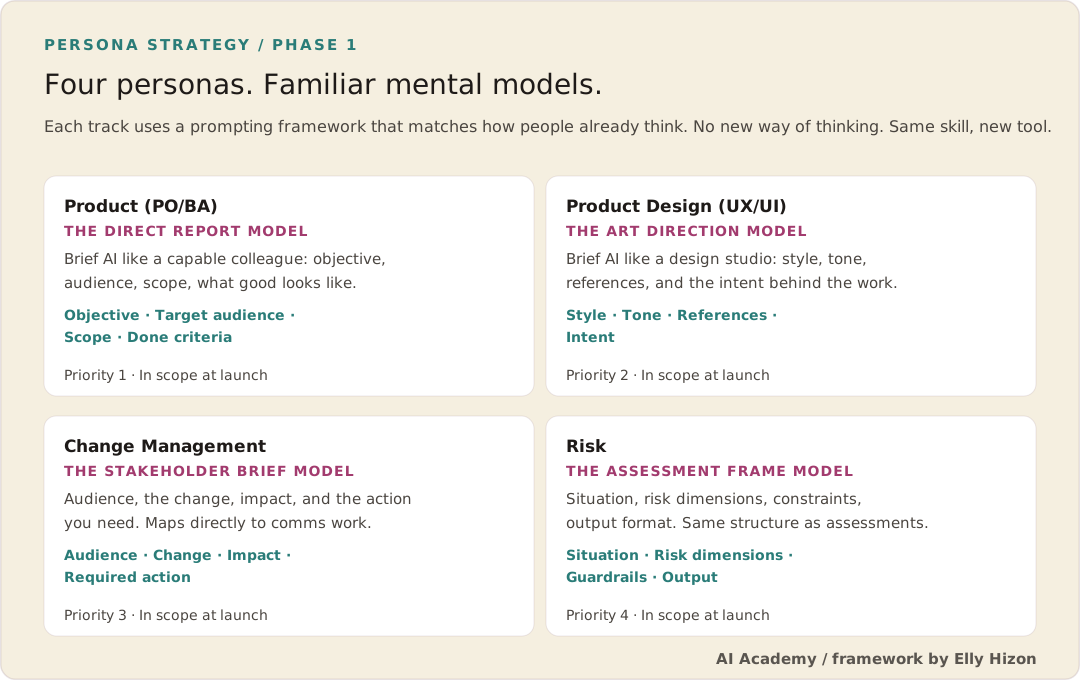
Phase 1 persona strategy: four non-technical tracks, each with a prompting framework that matches how people already think. Familiar mental models, not a new language.
The five-level maturity ladder
L0 to L2 are shared foundations for every persona. L3 branches into role-specific tracks with real roadmap scenarios. L4 is multi-persona swarming: multiple agents under human direction. The levelling quiz places you at the right starting point. You do not have to begin at L0 if you are already past it.
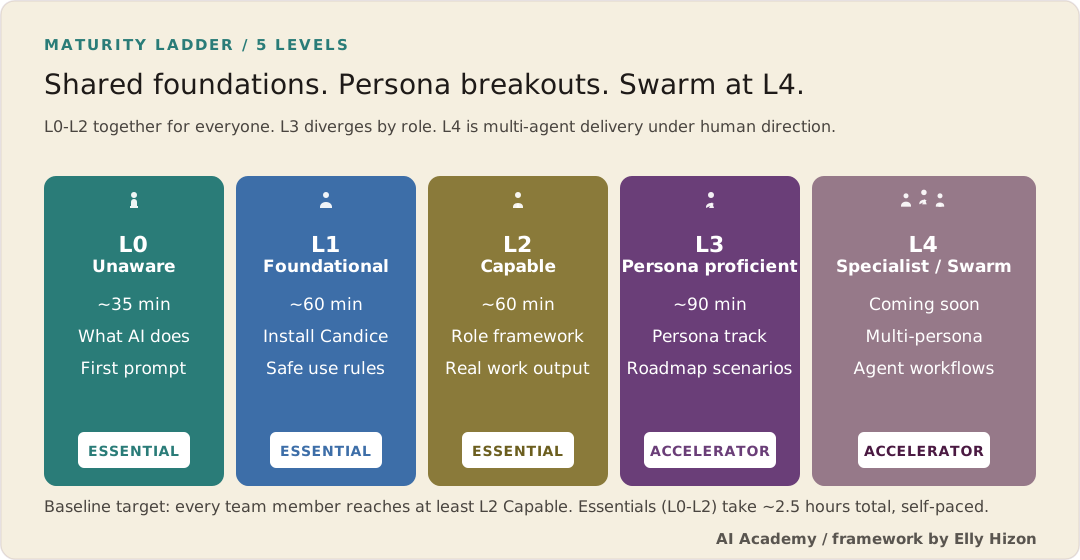
The maturity ladder: shared essentials through L2 (~2.5 hours total), persona breakouts at L3, swarm workflows at L4. Baseline target: every team member reaches at least L2 Capable.
Teacher Candice: learn by installing an agent
The most important factor in AI adoption is not teaching people how to prompt. It is helping them experience what AI is capable of. Teacher Candice is implemented as a Cursor rules file students download and install. The act of installation is the first lesson: drop the file in, open Cursor, and the AI introduces itself, knows your role, and has a lesson plan ready.
Download → Install → Open Cursor → Learn interactively → Get scored → Record progress
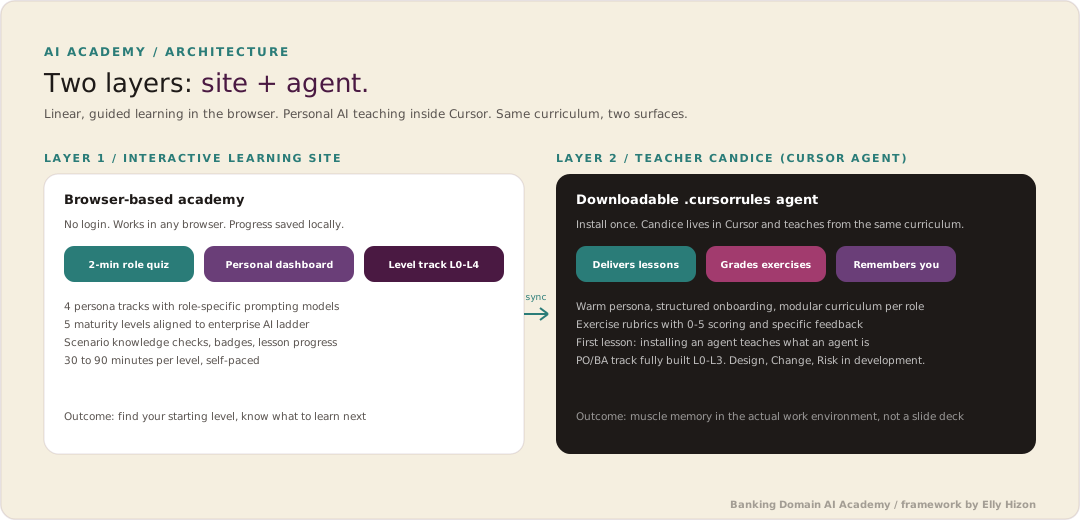
Candice delivers lessons conversationally, grades exercises on a 0–5 rubric with specific feedback, remembers your name and level, and adjusts framing to where you are. One agent file scales to every learner without a human facilitator in the room.
Two layers. One curriculum.
Layer 1 is the interactive learning site: a linear web experience that walks learners through a short quiz, personalised dashboard, level track, scenario knowledge checks, and badge progression. No login. Works in any browser. Progress saved locally.
Layer 2 is Teacher Candice: a downloadable agent package students install in Cursor. Same curriculum, delivered conversationally inside the tool they will use for real work. PO/BA track is fully built from L0 through L3. Design, Change, and Risk tracks are in development.
Personal Everyday Banking
Get confident with AI and Cursor. At your pace, for the roles that shape the product.
Customised for your role, matched to your experience level, and guided by an AI teacher that works with you inside Cursor.
Start your learning journeyHow it works
Four steps to get started. 30 to 90 minutes to complete a level.
It only takes about 2 minutes to set up before you can start any lesson. After that, go through each level at your own pace, one lesson at a time.
Choose your role, then either take a short quiz to find the right level or pick one yourself. Takes about 2 minutes.
Your level, your lessons, and your progress tracker. Everything is tailored to your role and ready to go.
Each lesson is 5 to 12 minutes. Some include hands-on exercises with Teacher Candice, an AI guide that lives inside Cursor and gives you scored feedback.
Each level ends with a short knowledge check. Pass it, earn your badge, and unlock the next level. Come back any time to review.
What success looks like
L2 Capable as the baseline
Every team member can use their role's prompting framework to produce structured, useful outputs. Levels 0 to 2 are Essential.
Guided path, no scheduling
A structured lesson sequence led by the site and Teacher Candice. No formal training sessions or mandatory calendar blocks. People learn when they have 15 minutes, not when a room is booked.
Role-appropriate confidence
Prompting AI feels like briefing a capable colleague, not writing a command. Each persona gets a framework that matches their existing mental model.
Four steps to start. Lessons that meet you in Cursor.
The onboarding flow takes about two minutes: pick your role, choose your starting level (or let the quiz guide you), land on a personalised dashboard, and begin. Lessons run 5 to 12 minutes each. Some include hands-on exercises with Teacher Candice inside Cursor, scored on the spot.
The learner journey: choose a role → personalised dashboard → install Candice in Cursor → complete lessons and earn badges. These three screens show the moments that matter most.
What's your role?
We'll tailor your learning path to how you actually work. Pick the one that fits best.
Requirements, user stories, stakeholder presentations, backlog grooming.
Research synthesis, UX copy, design briefs, accessibility reviews.
Solution options, integration patterns, architecture decision records.
Architecture assessments, technical briefs, platform decisions.
Installing Candice
Follow these steps to get Candice set up. You won't need to find any hidden folders. Cursor will handle the installation for you.
- Download the agent package. Click the download button below to save
learning-agent.zipto your computer. - Unzip the file. Right-click the zip and extract it. You should end up with a folder called
learning-agent. - Open Cursor and start a new chat in Agent mode.
- Drag the folder into the chat. Drag the entire
learning-agentfolder into the Cursor chat window. - Ask Cursor to install it. Copy and paste the prompt below.
Install the learning agent
I've attached the agent package for the AI Academy learning agent. Please install the files as follows:
1. Copy all .mdc files and subfolders into my .cursor/rules/ folder.
2. Copy the commands/ folder into my .cursor/ folder.
Confirm once it's done.
Level 1
Foundational
You're done! · You know the basics and have Cursor installed.
More in the flow
The personalised dashboard and interactive Cursor tour sit between onboarding and the Candice install lesson. Same curriculum, more context for how learners navigate the real tool.
Level 0
Unaware
Limited or no exposure to AI tools and concepts.
Know what AI does and how it works at a practical level.
5 minutes total · Choose a lesson to start.Know the difference between Copilot and Cursor, and when to use each.
8 minutes totalType a prompt, get a response, and refine it with a follow-up.
Interactive tour · click the pins
Plan Mode improves agent outcomes and accuracy
1 2 3 4 5 6 7 8In the previous lesson we introduced Cursor as an agentic AI tool: AI that can take sequences of steps, read documents, and produce structured output. When you are doing real work as a PO or BA, Agent mode is the one doing the heavy lifting.
Learning outcomes are practical, not theoretical: use AI confidently and safely, produce real work outputs (briefs, stories, research syntheses), and build reusable prompt templates your team can share. Not practice exercises. Your actual work.
Enablement as product, not an event.
The academy turns platform investment into adoption. People who complete L2 can contribute to and draw from the domain's shared AI knowledge base. People who reach L3 produce role-specific outputs against real roadmap scenarios. The Context Lifecycle, ADG, and every downstream tool depend on this layer working.
What changed
| Before | After |
|---|---|
| AI capability siloed in individual experts | Structured linear path from L0 to L2 for every persona, guided by the site and Candice |
| Non-technical roles had no AI on-ramp | Persona-specific prompting frameworks matched to existing mental models |
| Training meant calendar blocks and slide decks | Interactive site plus in-Cursor agent. Muscle memory in the real environment |
| Infrastructure ready before culture was | Enablement programme running in parallel with platform scale |
The hardest part of enterprise AI is not the model.
It is adoption. And adoption only happens when people experience AI doing useful work in their own context, at their own level, without needing permission or a technical champion in the room. The academy was my answer to the gap I identified in the Context Lifecycle case study: the system scaled faster than the change management. I would invest in enablement in parallel with the technical build, not sequentially.
What I am most proud of is treating enablement as a product problem with the same rigour as the platform: persona research, level design, agent architecture, interactive UX, and measurable outcomes. Teacher Candice is not a chatbot wrapper. She is a curriculum delivery system that happens to teach what an agent is by making you install one.
Four persona tracks. Five maturity levels. Two layers. One goal: every person across a domain of thousands can reach for AI instinctively, safely, and at the quality bar the organisation requires.